
FOOD & BEVERAGE
Keep Materials Moving. Keep Operations Clean and Efficient.
Food and beverage operations depend on reliable material movement across receiving, storage, processing, packaging and dispatch.
From raw materials and ingredients to packaging supplies, palletised products and finished goods, the handling solution needs to suit both the movement requirement and the operating environment.
NGT helps food and beverage operations evaluate material handling, lifting, storage and intralogistics solutions around their actual workflow — supported by Sales, Service, Rentals and Spares.
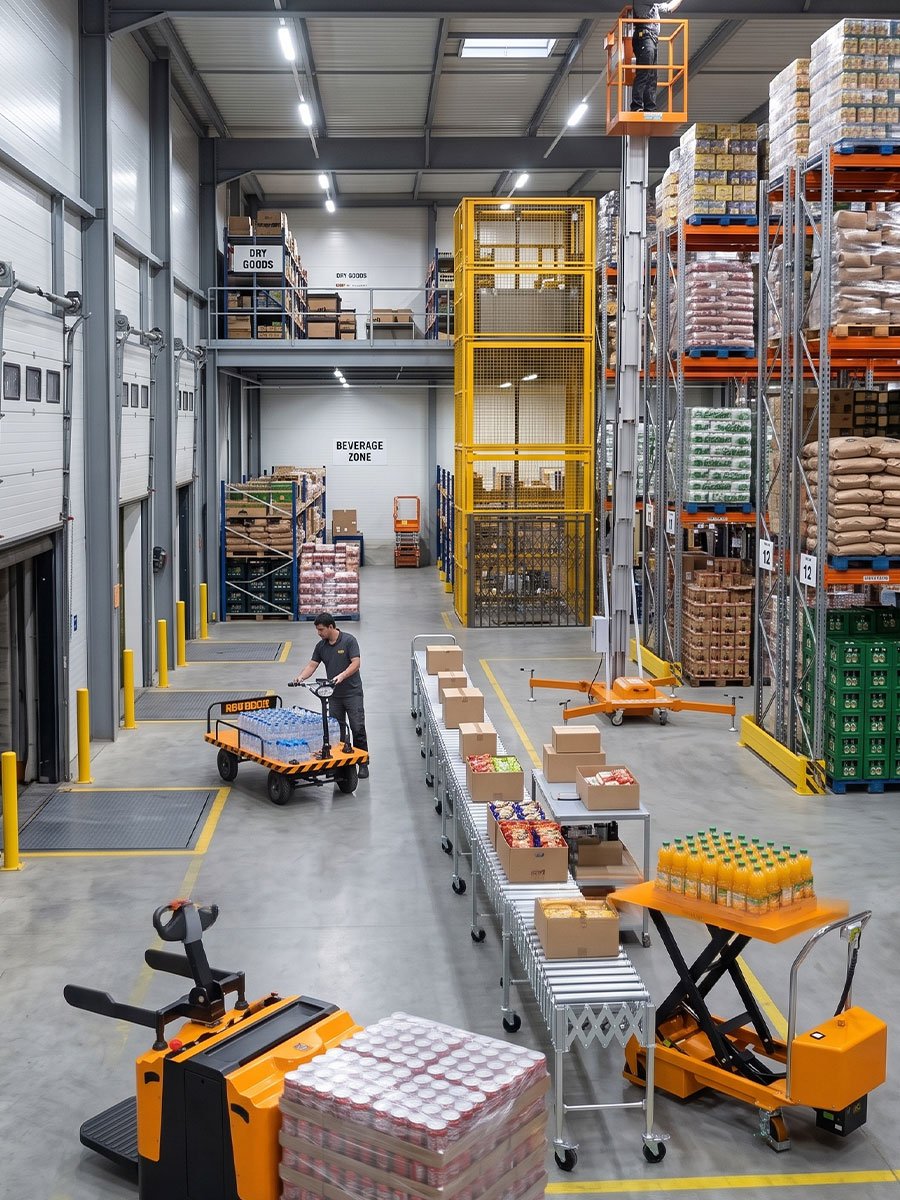
MATERIAL HANDLING WHERE CLEANLINESS MATTERS
The material-handling solution must fit the process environment too.
Food and beverage facilities can involve very different handling conditions within the same operation.
Raw materials may arrive on pallets, ingredients may move towards processing areas, packaging materials need to reach production, and finished products must move through packing, storage and dispatch.
At the same time, the operating environment may involve cleaning procedures, moisture, temperature variation or hygiene requirements that affect equipment selection.
That means the right solution should be evaluated around both what needs to move and where the equipment needs to operate.
The environment is part of the equipment requirement.
FOOD & BEVERAGE CHALLENGES
Efficient material movement should support the process — not complicate it.
01
Maintaining Clean Operating Areas
Material-handling equipment should support the facility’s cleaning and housekeeping practices and be appropriate for the area in which it operates.
02
Frequent Pallet & Carton Movement
Raw materials, packaging supplies and finished goods may move repeatedly between receiving, storage, production, packing and dispatch.
03
Handling Different Load Formats
Operations may involve pallets, crates, cartons, bags, containers, drums or other load formats requiring different handling approaches.
04
Moving Materials Into Production
Ingredients, packaging materials and other supplies need to reach production or packing areas without creating unnecessary internal handling.
05
Restricted & Busy Operating Areas
Production equipment, storage areas, people and internal traffic can limit manoeuvring space and affect equipment selection.
06
Environmental Conditions
Moisture, cleaning procedures, temperature or other site conditions may influence the type of material-handling equipment appropriate for an application.
07
Equipment Availability
When frequently used handling equipment is unavailable, receiving, production supply, storage and dispatch activity can be affected.
08
Changing Production & Demand
Product launches, seasonal demand, additional lines or facility expansion can create new material-handling requirements.
WHERE NGT FITS INTO THE FOOD & BEVERAGE FLOW
Material handling across the operational journey
01
Receiving
Move incoming ingredients, raw materials, packaging supplies and palletised goods into the facility.
Relevant NGT Solution Areas
- Pallet Trucks
- Powered Pallet Trucks
- Forklifts
- Dock Solutions
- Telescopic Belt Conveyors
02
Raw Material Storage
Support movement, storage and retrieval of suitable materials within warehouse or stores areas.
Relevant NGT Solution Areas
- Pallet Trucks
- Stainless Steel Pallet Truck
- Stackers
- Reach Trucks
- Forklifts
- Storage & Racking Solutions
03
Production Supply
Move suitable ingredients, packaging materials and other supplies towards production or processing areas.
Relevant NGT Solution Areas
- Pallet Trucks
- Powered Pallet Trucks
- Stackers
- Vacuum Lifting Solutions
- Customized Material Handling
04
Processing & Packing
Support movement between process areas, packaging lines and internal staging points.
Relevant NGT Solution Areas
- Pallet Trucks
- Scissor Lifts
- Conveyor & Material Flow Solutions
- Vacuum Lifting Solutions
- Customized Handling Equipment
05
Finished Goods
Move packed products towards palletisation, staging or warehouse storage.
Relevant NGT Solution Areas
- Pallet Trucks
- Powered Pallet Trucks
- Stackers
- Forklifts
- Stretch Wrapping Solutions
- Conveyor Solutions
06
Dispatch
Move palletised finished goods from storage or staging areas towards outbound vehicles.
Relevant NGT Solution Areas
- Forklifts
- Pallet Trucks
- Powered Pallet Trucks
- Dock Solutions
- Telescopic Belt Conveyors
Final equipment selection depends on the load, operating environment, cleaning requirements, storage configuration, route, available space and expected operating duty.
HOW NGT CAN HELP
Start with the application — and the environment around it.
Material-handling requirements in food and beverage facilities should be evaluated around both the handling task and the conditions in which the equipment will operate.
01
Understand the Load
Identify what needs to move, including weight, dimensions, packaging format and method of support.
02
Understand the Operating Environment
Consider floor conditions, moisture, cleaning practices, temperature and other relevant site conditions.
03
Select the Relevant Handling Method
Determine whether the requirement involves transportation, lifting, stacking, positioning, storage or process transfer.
04
Evaluate Hygiene-Related Requirements
Where cleaning or hygiene considerations affect equipment selection, those requirements should be identified before the solution is finalised.
05
Address Non-Standard Applications
Where standard equipment does not adequately fit the load, route or production interface, customized material-handling solutions can be evaluated.
06
Support Equipment After Deployment
Service, preventive maintenance and spare-parts support help keep material-handling equipment available for daily operations.
APPLICATION SUITABILITY
Clean operations need appropriately selected equipment.
Material-handling equipment used around food and beverage operations may be exposed to conditions that differ significantly from those in a conventional warehouse.
The application may involve:
- frequent cleaning
- moisture
- food or beverage residues
- temperature variation
- restricted production areas
- hygiene-controlled operating practices
- aggressive cleaning agents
- special material or surface requirements
These conditions should form part of the equipment-selection process.
Where the operating environment requires specific materials, protection levels or hygienic characteristics, suitability should be technically confirmed before deployment.
Equipment material, corrosion resistance, electrical protection, cleanability and suitability for hygiene-sensitive areas must be confirmed for the specific model and application.
CONNECTED MATERIAL FLOW
The operation works better when each movement supports the next.
Food and beverage facilities can involve several connected material movements:
Receiving → Storage → Production Supply → Processing → Packing → Finished Goods → Dispatch
Improving one stage without considering the next can simply move the bottleneck somewhere else.
Depending on the application, the overall material flow may involve a combination of:
- pallet movement
- stacking and storage
- lifting and positioning
- conveyor movement
- packaging support
- loading and unloading
- customized handling equipment
NGT can help evaluate these requirements as connected parts of the operation rather than isolated equipment purchases.
SALES | SERVICE | RENTALS | SPARES
Daily operations need equipment that stays available.
Where material-handling equipment supports receiving, production supply, storage and dispatch, ongoing support becomes an important part of the overall solution.
SALES
Material handling and intralogistics equipment for appropriate food, beverage, warehouse and industrial applications.
SERVICE
Technical support, preventive maintenance and breakdown-service capability.
RENTALS
Rental equipment options for suitable temporary, peak-demand or additional-capacity requirements.
SPARES
Spare-parts support for material-handling equipment.
NGT — Complete Intralogistics Solutions
Sales | Service | Rentals | Spares
WHY NGT FOR FOOD & BEVERAGE?
A material-handling approach built around the operation.
01
Application-Oriented Selection
Start with the load, movement and environment rather than simply choosing equipment from a catalogue.
02
Broad Intralogistics Portfolio
Evaluate movement, lifting, storage, packaging, loading and material-flow requirements across multiple solution categories.
03
Standard + Customized Solutions
Use standard equipment where appropriate and evaluate customization where the application requires something different.
04
Environment Consideration
Operating conditions such as cleaning, moisture, space and workflow can form part of the equipment-selection discussion.
05
Sales + Rentals
Different operational requirements can be evaluated through purchase or rental options where applicable.
06
Service & Spare Support
NGT’s proposition extends beyond equipment supply through technical service, maintenance and spare-parts support.
HELP US UNDERSTAND YOUR APPLICATION
The operating environment is part of the equipment requirement.
01
What are you moving?
Pallets, cartons, bags, crates, drums, ingredients, packaging materials or finished goods.
02
What is the load?
Maximum weight, dimensions, load format and method of support.
03
Where does it move?
Receiving, warehouse, production interface, packing, finished-goods storage or dispatch.
04
How does it need to be handled?
Transported, lifted, stacked, positioned, transferred or moved between operating levels.
05
What is the environment?
Floor condition, moisture, temperature, cleaning procedures and any relevant site conditions.
06
Are there special hygiene requirements?
Identify any material, cleaning, contamination-control or equipment-construction requirements before equipment selection.
NGT can then evaluate the relevant material-handling solution and identify where further technical qualification may be required.
DISCUSS YOUR FOOD & BEVERAGE REQUIREMENT
Better material flow supports better production flow.
Whether you are setting up a new facility, modifying a production area, expanding capacity or solving a specific material-handling challenge, start with the actual application and operating environment.
Tell Us What You Need to Move and Where It Needs to Operate.
We’ll help evaluate the relevant material-handling and intralogistics solution for your food and beverage operation.