
by Site Admin
Share
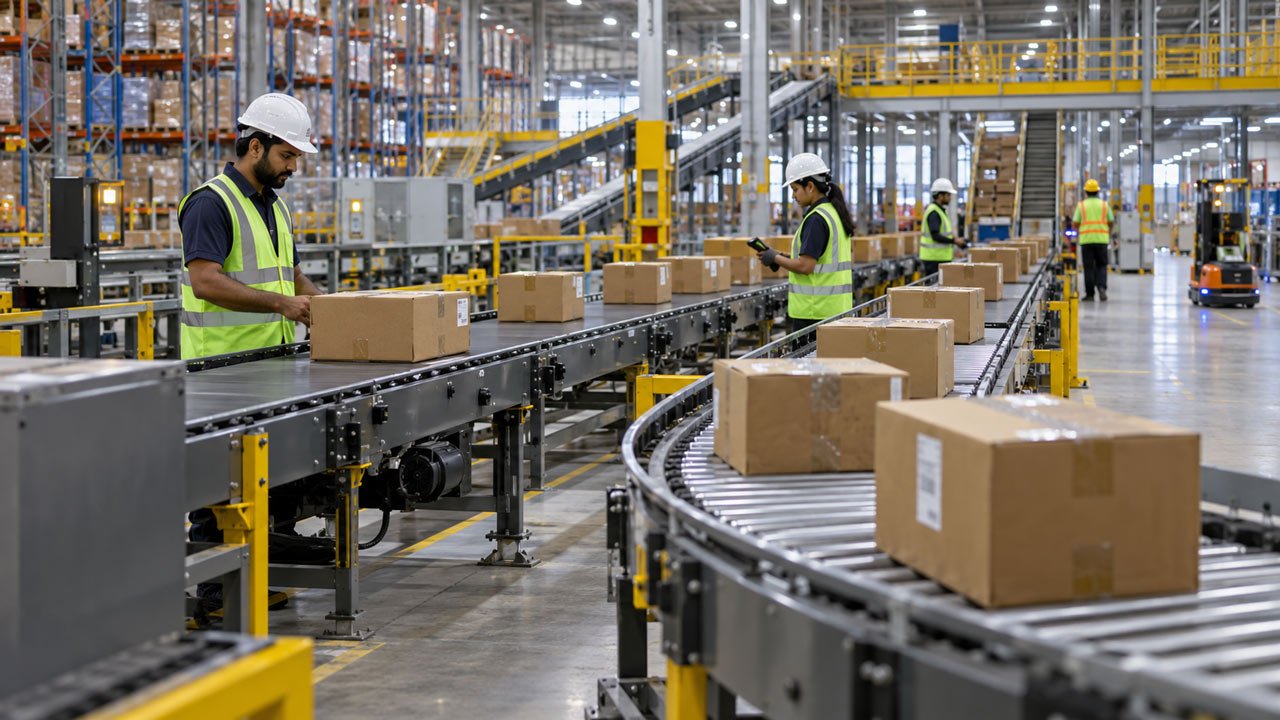
In many warehouses and factories, a significant amount of time is spent moving cartons, components and materials from one process to another.
When that movement depends entirely on manual handling, productivity can be inconsistent and operators may spend time walking instead of performing value-added tasks.
Conveyor systems can help create a more controlled and continuous flow of material.
NGT’s conveyor portfolio includes belt conveyors, roller conveyors, flexible conveyors and pneumatic arm sorting systems.
1. Belt Conveyors
Belt conveyors are suitable for moving a wide range of products and packages.
The brochure lists configurations including:
- horizontal;
- inclined or declined;
- curved;
- spacing;
- weighing;
- plastic modular.
This flexibility makes belt conveyors suitable for many warehouse and production applications.
2. Roller Conveyors
Roller conveyors are commonly used for cartons, totes and other loads with a stable base.
NGT’s conveyor range includes:
- gravity roller conveyors;
- motorized roller conveyors;
- motor-driven roller systems;
- curved sections;
- merge sections;
- zero-pressure accumulation.
Zero-pressure accumulation systems can help manage product spacing while reducing contact between cartons.
3. Flexible Conveyors
Flexible conveyors are useful where the loading point or working area changes.
They can be extended, retracted and repositioned based on operational requirements.
4. Sorting Systems
As throughput increases, products may need to be automatically diverted toward different destinations.
Benefits of a Well-Designed Conveyor System
A properly planned conveyor system can help:
- reduce unnecessary manual movement;
- create consistent material flow;
- reduce congestion;
- improve process coordination;
- support higher throughput;
- improve operator ergonomics.
Conveyor Systems Should Be Designed Around the Process
A conveyor should not be treated as an isolated piece of equipment.
Before implementation, businesses should understand:
- where material enters the process;
- where it needs to go;
- product dimensions;
- product weight;
- required speed;
- accumulation requirements;
- sorting points;
- interaction with operators;
- connection with packaging or loading systems.
Conclusion
The value of a conveyor system comes from how well it integrates with the entire operation.
The goal should be to create a smooth material-flow path from receiving to storage, production, packaging or dispatch.
Looking to improve internal material flow?
NGT can help evaluate conveyor layouts and equipment combinations suited to your operation.