
MANUFACTURING
Keep Production Moving. From Stores to Shopfloor to Dispatch.
Manufacturing depends on more than machines and production lines.
Raw materials, components, work-in-progress and finished goods all need to move through the facility safely, efficiently and at the right time.
NGT helps manufacturing operations evaluate the material handling, lifting, storage and intralogistics solutions needed to support movement across the plant — backed by Sales, Service, Rentals and Spares.
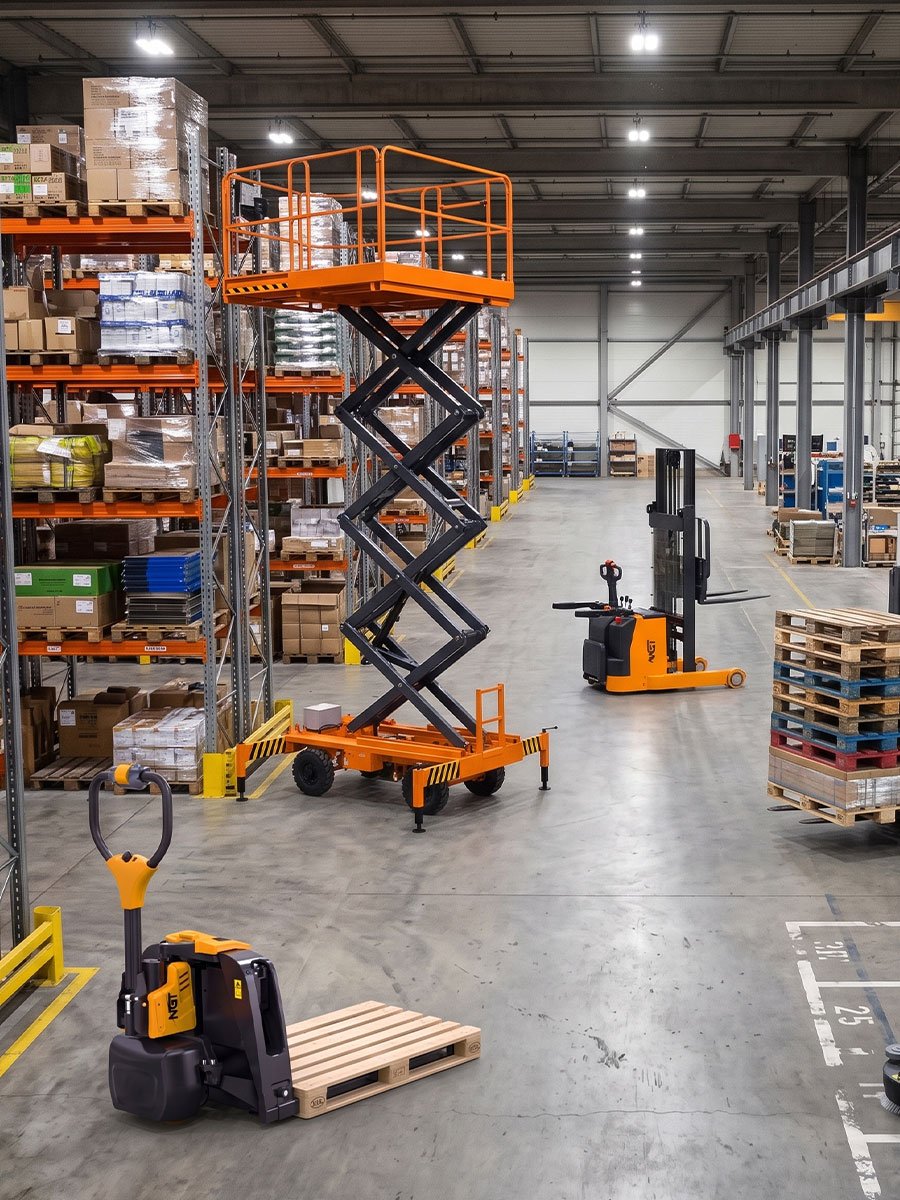
MATERIAL FLOW INSIDE MANUFACTURING
Production efficiency depends on what happens between the processes too.
A production machine may perform its task efficiently, but the operation can still slow down if materials do not reach it when required.
Manufacturing facilities need to move raw materials, pallets, components, dies, tools, work-in-progress and finished goods between multiple areas of the plant.
Different loads, lifting heights, aisle conditions, process interfaces and operating environments can require different handling solutions.
That is why material handling should be evaluated as part of the manufacturing flow — not as an isolated equipment purchase.
MANUFACTURING CHALLENGES
When material movement becomes a bottleneck, production feels it.
01
Timely Material Supply
Production areas depend on materials and components reaching the right location when they are needed.
02
Moving Different Types of Loads
Factories may handle pallets, bins, components, fabricated parts, reels, dies, tooling and other loads with very different handling requirements.
03
Work-in-Progress Movement
Materials often move through several production stages before completion, creating repeated internal handling requirements.
04
Limited Space Around Production
Machine layouts, aisles, workstations and safety zones can restrict manoeuvring space and influence equipment selection.
05
Lifting & Positioning Requirements
Some manufacturing tasks require more than horizontal transport — loads may need to be lifted, positioned, transferred or presented at a suitable working height.
06
Reducing Unnecessary Manual Handling
Repeated lifting, carrying or repositioning can create inefficient workflows where appropriate material-handling equipment could be evaluated.
07
Equipment Availability
A material-handling equipment breakdown can disrupt movement between stores, production and dispatch areas.
08
Changing Production Requirements
New products, process changes, capacity expansion and factory-layout changes can create new material-handling requirements over time.
WHERE NGT FITS INTO THE MANUFACTURING FLOW
Material handling across the plant journey
01
Receiving
Move incoming raw materials, components and palletised goods from vehicles into the facility.
Relevant NGT Solution Areas
- Forklifts
- Pallet Trucks
- Powered Pallet Trucks
- Dock Solutions
- Scissor Lifts
02
Stores & Material Storage
Move and position materials within warehouse, stores or raw-material storage areas.
Relevant NGT Solution Areas
- Reach Trucks
- Forklifts
- Stackers
- Pallet Trucks
- Storage & Racking Solutions
03
Production Supply
Move materials from stores or staging locations towards production areas.
Relevant NGT Solution Areas
- Powered Pallet Trucks
- Pallet Trucks
- Stackers
- Forklifts
- Conveyor & Material Flow Solutions
04
Work-in-Progress Movement
Support movement between manufacturing stages, machines, assembly areas or process locations.
Relevant NGT Solution Areas
- Pallet Trucks
- Powered Pallet Trucks
- Stackers
- Scissor Lifts
- Customized Material Handling Equipment
- Conveyor Solutions
05
Finished Goods
Move completed products towards inspection, packing, storage or staging.
Relevant NGT Solution Areas
- Forklifts
- Pallet Trucks
- Powered Pallet Trucks
- Stackers
- Stretch Wrapping Solutions
- Material Flow Solutions
06
Dispatch
Support movement of finished goods from staging areas towards outbound loading.
Relevant NGT Solution Areas
- Forklifts
- Pallet Trucks
- Dock Solutions
- Telescopic Belt Conveyors
- Loading Solutions
Final equipment selection depends on the load, handling interface, lifting requirement, travel route, operating environment, available space and required operating duty.
HOW NGT CAN HELP
The right solution starts with understanding the material movement.
NGT approaches manufacturing requirements around the actual application rather than selecting equipment from the product name alone.
01
Understand the Load
Evaluate what needs to be moved, including its weight, dimensions, shape, support method and handling points.
02
Understand the Movement
Identify where the material starts, where it needs to go and what happens between those points.
03
Select the Relevant Equipment
Evaluate material-handling equipment suited to the required transport, lifting, stacking, positioning or transfer task.
04
Address Non-Standard Requirements
Where conventional equipment does not adequately match the load or process, customized material-handling solutions can be evaluated.
05
Connect Multiple Process Areas
Where movement spans stores, production and dispatch, complementary equipment or material-flow solutions can be considered together.
06
Support Equipment After Deployment
Service, maintenance and spare-parts support help keep handling equipment available for daily operations.
STANDARD EQUIPMENT MAY NOT SOLVE EVERY MANUFACTURING REQUIREMENT
Some loads need a different approach.
Manufacturing environments frequently handle materials that do not behave like a conventional pallet.
A requirement may involve:
- unusual load dimensions
- restricted fork-entry points
- rolls or reels
- tooling or dies
- components requiring specific positioning
- limited operating space
- unusual lifting or transfer heights
- process-specific handling interfaces
Where standard equipment is not sufficient, NGT can evaluate a customized material-handling approach based on the actual requirement.
SALES | SERVICE | RENTALS | SPARES
Production does not stop after the equipment is delivered.
Material-handling equipment often becomes part of the everyday manufacturing process.
That makes ongoing equipment support an important part of the solution.
SALES
Material handling and intralogistics equipment for manufacturing and industrial requirements.
SERVICE
Technical support, preventive maintenance and breakdown-service capability.
RENTALS
Rental equipment options for suitable temporary, additional or operational requirements.
SPARES
Spare-parts support for material-handling equipment.
NGT — Complete Intralogistics Solutions
Sales | Service | Rentals | Spares
WHY NGT FOR MANUFACTURING?
A material-handling partner that looks beyond a single machine.
01
Application-Oriented Approach
NGT starts by understanding what needs to move and how the operation works.
02
Broad Equipment Portfolio
Evaluate multiple lifting, movement, storage, loading and material-flow categories through one solution partner.
03
Standard + Customized Solutions
Use a standard solution where it fits and evaluate customization where the application requires something different.
04
Manufacturing Flow Perspective
Material handling can be evaluated across receiving, stores, production, WIP and finished-goods movement rather than one isolated activity.
05
Sales + Rentals
Different operational situations may call for ownership or rental depending on the requirement.
06
Service & Spare Support
NGT supports equipment beyond supply through service, maintenance and spare-parts capability.
HELP US UNDERSTAND YOUR APPLICATION
The right equipment depends on the actual manufacturing requirement.
01
What are you moving?
Pallets, components, bins, finished goods, reels, tooling, fabricated parts or another load.
02
What does it weigh?
Maximum weight and approximate dimensions of the load.
03
Where does it move?
From receiving, stores or staging to a machine, production area, inspection, packing or dispatch location.
04
How does it need to be handled?
Transported, lifted, stacked, positioned, transferred or moved vertically.
05
What space is available?
Aisle width, turning area, doorway, machine clearance and other layout restrictions.
06
What is the operating environment?
Floor condition, gradients, operating hours, frequency of movement and any relevant environmental requirements.
NGT can use this information to evaluate the relevant equipment or solution route for the application.
DISCUSS YOUR MANUFACTURING REQUIREMENT
Better production flow starts with better material movement.
Whether you are setting up a new manufacturing facility, expanding capacity, modifying a process or solving a specific handling challenge, start with the actual material movement.
Tell NGT What Needs to Move.
We’ll help evaluate the relevant material-handling and intralogistics solution for your manufacturing operation.